A drill is just a round with a purpose. These are the batting cage drills that actually transfer to games — grouped from tee work (where you fix the swing) to toss and machine work (where you test it) to competitive games (where you prove it under pressure). Each one lists what it fixes, how to do it, and the gear you need.
New to structuring a session? Start with our batting cage practice guide for a full session plan, then use these drills to fill the rounds. For the machine rounds below, our guide to hitting off a pitching machine covers timing and speed setup.
Tee drills
The tee is where you fix mechanics — nothing is moving, so you can isolate one thing at a time.

High-tee / low-tee
Fixes: Matching your swing plane to high and low pitches
Alternate rounds with the tee at the top and bottom of your zone. Feel how the barrel works up to the low pitch and stays flatter to the high one instead of one flat swing for everything.
Gear: Batting tee
Inside / outside tee
Fixes: Covering both edges of the plate
Move the tee off the inside corner (turn and pull) and the outside corner (stay through it and drive it oppo). Trains you to keep your hands inside the ball.
Gear: Batting tee
Top-hand only
Fixes: Barrel control and palm-up contact
Choke up, swing with just your top hand off a tee. Exposes a pushy or casting swing and teaches you to drive the barrel to the ball with your top hand.
Batting tee, training bat (optional)
Soft toss & front toss drills
Add a moving ball at a controlled speed to work on timing and contact point.
Front toss
Fixes: Timing and seeing the ball from the pitcher's slot
A partner tosses underhand from ~15–20 feet behind a protective screen. The closest thing to live BP for timing — take rounds of 10 with a clear intent each round.
Gear: Protective screen (soft-toss/front-toss screen), balls
Side soft toss
Fixes: Quick hands and consistent contact point
A partner tosses from the side into a net at your front hip. Work on letting the ball travel and squaring it up out front. Great for high-rep contact work in a tight space.
Gear: Soft-toss net, balls
Rapid-fire toss
Fixes: Hand quickness and reset between swings
The tosser feeds a new ball the instant you finish, so you reset quickly and stay short to the ball. Keep it controlled — quality contact, not chaos.
Pitching machine drills
Test the swing against real velocity and practice your in-game approach.
Timing ladder
Fixes: Adjusting to velocity
Start the machine at a comfortable speed and bump it up a few mph each round. Teaches you to start your load earlier as speed climbs while still finishing balanced.
Gear: Pitching machine, balls
Two-strike round
Fixes: Battling with a shorter, controlled swing
Choke up, widen your stance, shorten the swing, and just put the ball in play hard. The single most game-transferable machine round you can take.
Gear: Pitching machine, balls
Situational / count round
Fixes: Approach and pitch selection
Competitive games
Add pressure so cage reps carry over to game at-bats.

27-out game
Fixes: Competing and valuing every swing
Every weak contact (soft grounder, pop-up, miss) is an out; hard line drives and solid contact keep the inning alive. Play to 27 outs. Adds pressure and focus to cage work.
Gear: Any (tee, toss, or machine)
Points round
Fixes: Rewarding quality contact
Score each swing: line drive = 2, hard grounder/liner = 1, weak contact or miss = 0. Race to a target or compete with a teammate. Keeps intent high across a full bucket.
Gear: Any (tee, toss, or machine)
Equipment that makes these drills work
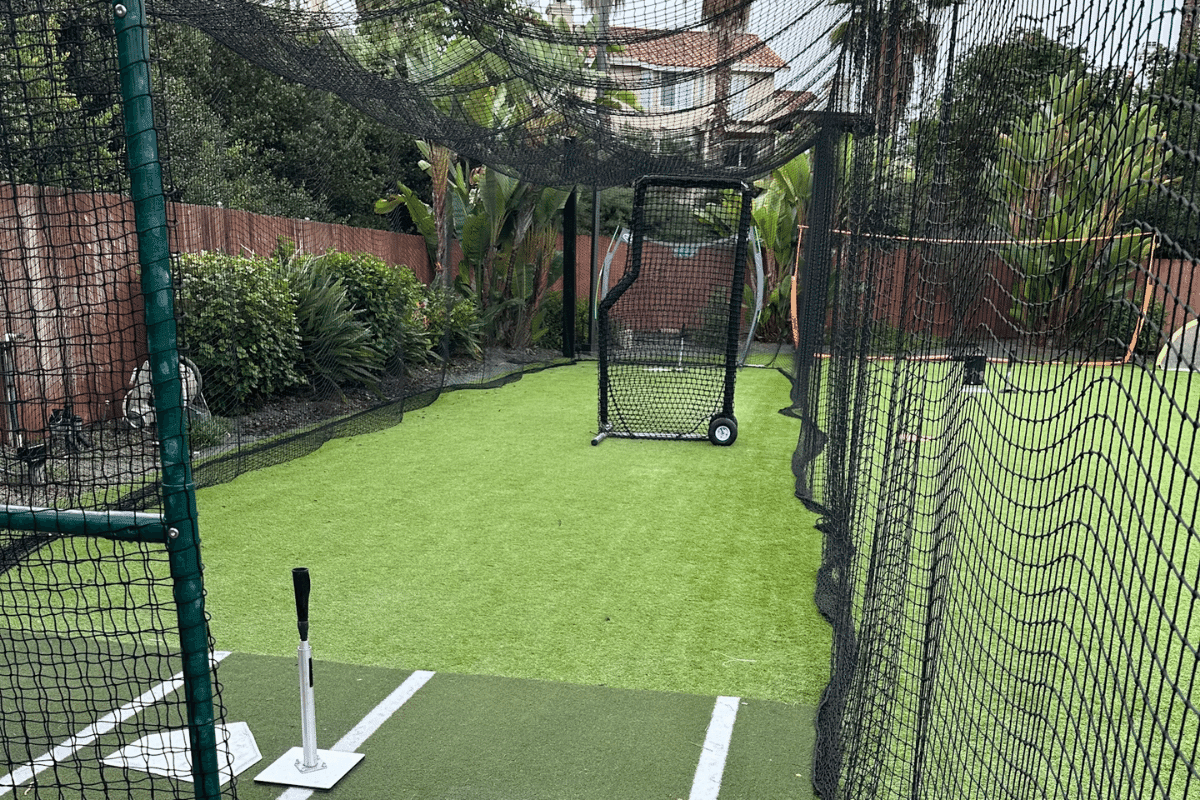
You don't need everything to start — a tee and a net cover most of the tee and toss drills. Add a screen and a machine as you build a home setup. Here's what each tool is for:
Batting tee
The foundation for half these drills. A sturdy, adjustable-height tee lets you isolate contact point and swing plane.
Soft-toss / hitting net
Contains the ball for side toss, rapid-fire, and oppo toss in a garage, yard, or cage. Look for a frame that folds down if you're short on space.
Protective screen
A front-toss or L-screen keeps the feeder safe when tossing or loading a machine — non-negotiable for machine and front-toss work.
Pitching machine
Adds repeatable velocity for timing ladders and situational rounds. Match the machine to the speeds you actually need, not the max on the box.
Training balls
Dimpled, lite-flite, or weighted balls let you get high-rep work safely in tight spaces and protect nets from wear.
Hitting mat / turf
Protects the floor and gives a consistent stance surface for tee and toss work at home.
Swinging the right bat matters too — see our bat sizing guide to make sure the player is set up to succeed.
Batting cage drills FAQ
- What are the best batting cage drills for beginners?
- Start on the tee — high/low tee and inside/outside tee build a repeatable swing without a moving ball to chase. Add side soft toss for timing once the swing feels consistent. Beginners should master contact and balance before moving to full machine speed.
- How many drills should I do in one cage session?
- Pick 2–4 drills per session and take a focused round (8–12 swings) of each, rather than rushing through all of them. Rotating a few drills with real intent beats hitting a whole bucket with no purpose. Rest between rounds so fatigue doesn't groove bad habits.
- What equipment do I need for batting cage drills?
- A batting tee and a soft-toss net cover most tee and toss drills. Front toss adds a protective screen. Machine drills need a pitching machine and balls. For tight spaces, dimpled or lite-flite training balls let you get high-rep work safely at home.
- Can I do these drills at home without a full batting cage?
- Yes — nearly all the tee and toss drills work with just a hitting net and a tee in a garage, yard, or driveway. A pitching machine and a longer net or cage let you add the machine drills. Many CageList listings also rent cage time by the hour if you want the full setup.
- What drill fixes rolling over and hitting weak ground balls?
- The opposite-field toss and opposite-field machine round are the fixes — driving the ball the other way forces you to let it travel and stay through it instead of getting out front and rolling over. Pair them with the two-tee path drill to clean up the swing path.
- One cue per round. Never run a mechanical checklist mid-swing — pick a single focus and hold it for the whole round.
- Quality over quantity. Forty focused swings beat a rushed bucket of 150 — rest between rounds and keep every rep game-speed.