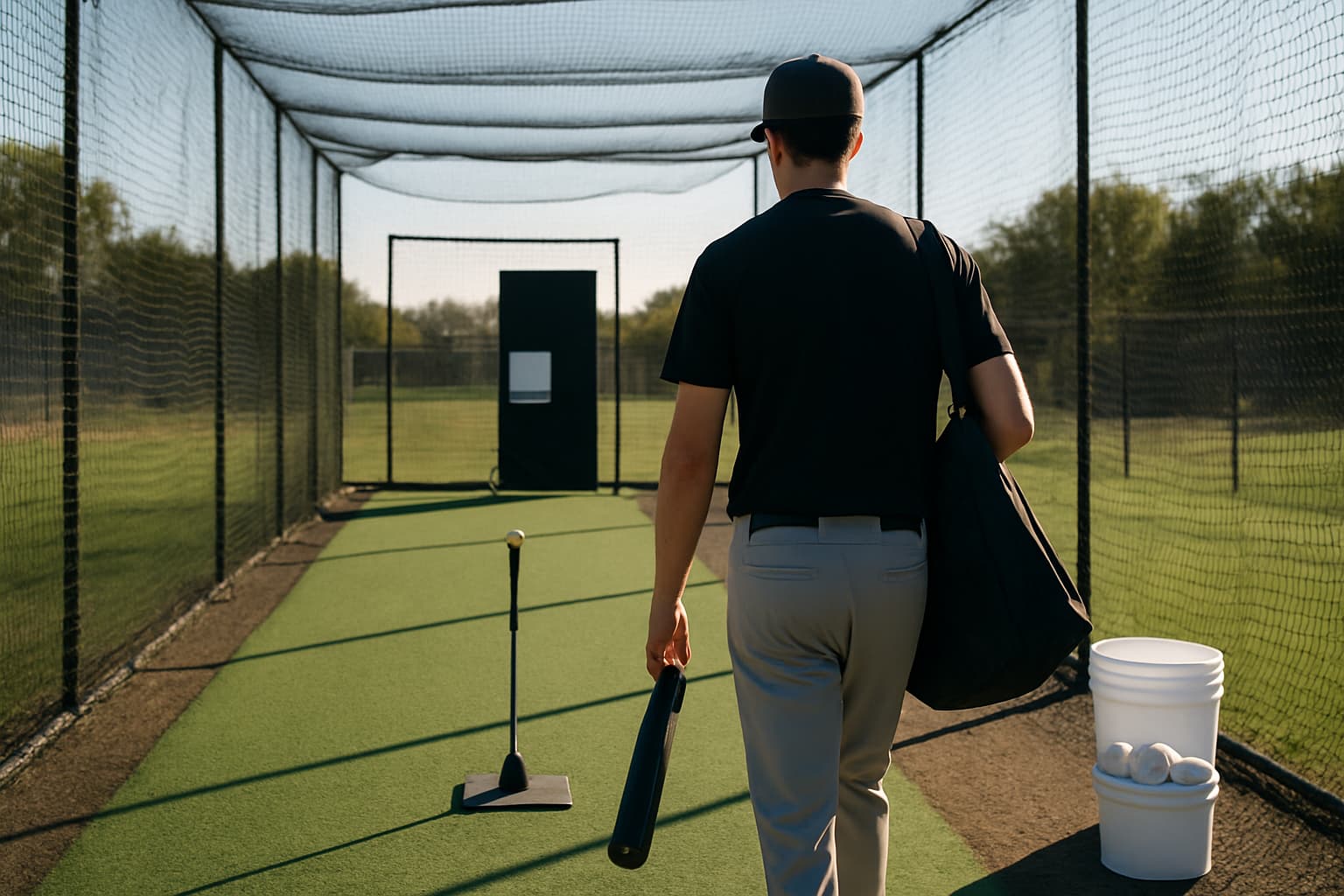
The best hitters in the world are not faster than everyone else. They are earlier. They see the pitch sooner, decide sooner, and commit sooner — and that fraction of a second is the difference between a strikeout and a line drive.
Pitch recognition is a learnable skill, and it's one of the most under-trained in the game. Here is exactly how it works and how to develop it — from the science, to the cues, to the drills you can run in any cage this week.
What Pitch Recognition Actually Means
Pitch recognition is not guessing what's coming. It's reading release-point and early ball-flight cues to make a high-probability decision before the ball is halfway to the plate. The reason it feels impossible is simple math:
You have roughly the first third of ball flight to decide, and most of that read has to happen before you can clearly see the seams. That's why elite hitters train their eyes to the front of the ball and the pitcher's hand — not the barrel.
The Cues Every Hitter Should Train
1. Release point
Different pitches often leave the hand from slightly different points. A curveball may release an inch or two higher; a slider may show a subtly different arm angle. These are small but consistent. Study the pitcher in warmups and early at-bats: where is the hand at release, and does it change by pitch type?
2. Tunnel and break point
Good pitchers throw fastballs and breaking balls through the same initial tunnel — the paths look identical until a late break. Your job is to notice when a pitch leaves that shared tunnel: drift straight down six inches and it's a curveball; a late arm-side dart is a slider. Train yourself to pick up the deviation point, not the final location.
3. Spin and grip
At higher levels hitters read spin — the red dot on a slurve, tight backspin on a four-seamer, the dead spot of a gyro slider. It takes years, but it starts with intent: during BP, track the spin instead of the barrel, every pitch.
4. Tempo and body cues
Some pitchers unknowingly change tempo, glove height, or effort level by pitch. You won't always find one — but when you do, it's the earliest read available, before the ball is even out of the hand.
Drills to Build Pitch Recognition
No-swing recognition drill
Take 15–20 pitches where your only job is to call the pitch out loud before it reaches the plate — no swings. Fastball, curve, changeup. Keep a tally of how often you're right. This forces active processing instead of passive watching.
Color-code / dot drill
Have a partner front-toss balls marked with colored dots. Call the color before you swing. It sounds gimmicky, but it forces your eyes to the front of the ball — exactly where the cues live.
Machine variety sets
If your cage machine throws multiple pitch types, set it to random. Now you don't know what's coming — identify and react. Start slow and raise the speed as your reads sharpen. A limited-flight vision trainer (below) is purpose-built for this.
Video and flashcard study
Occlusion training — watching a clip of a delivery that pauses at release and asking "what is it?" — builds recognition off the field. Even studying a pitcher's release on video before a game measurably speeds up your in-game reads.
Progressive-distance vision work
Small-ball vision machines let you move close and face game-speed reactions in a garage or cage. Because the ball is smaller and the distance shorter, the eyes work harder than they do against a full-size machine — then the real thing feels slower.
Match the Training to the Age
In-Game Application
Before every at-bat, take 30 seconds to recall what you saw from this pitcher earlier. What's their best pitch? What do they throw when they're behind? What do they love in an 0–2 count? Then use the first pitch of your at-bat as information, not just a swing: did the fastball ride more than expected? Did the curve start at your eyes and finish at your knees? Log it mentally and adjust.
Common Mistakes
- Watching the barrel, not the ball. Recognition cues are at the hand and the front of the ball — that's where your eyes belong.
- Guessing instead of reading. Sitting dead-red and hoping isn't recognition; it's a gamble that collapses against good pitching.
- Passive tracking. If you don't call the pitch and check whether you were right, you're not training the skill — you're just watching.
- Only training at one speed. Reads built at 60 mph don't automatically transfer to 85. Progress the speed.
The Mental Side
Good pitch recognition requires aggression, not passivity. You don't get better by taking a passive read — you get better by making an active decision (swing or no swing) and tracking whether you were right. The best drill is simply this: care about the answer, every pitch. Don't let one go by without calling it.
Practice this in a private cage. These drills work best where you control the machine settings and can take uninterrupted rounds. Find a batting cage near you and put in the reps.
Frequently Asked Questions
At what age should players start working on pitch recognition?
Simplified versions — tracking spin, calling fastball or not — can start at 10 or 11. Formal pitch-type recognition is most productive around 13–14, when players begin facing breaking balls regularly.
Can pitch recognition be trained without a live pitcher?
Yes. Pitching machines with pitch variety, small-ball vision trainers, video study of release points, and cage drills like the no-swing drill all build the skill effectively.
How long does it take to improve?
Most players see measurable improvement in 4–6 weeks of intentional training. Elite recognition takes years of reps at progressively faster speeds.
Does hitting off a machine actually help recognition?
A single-speed machine trains timing more than recognition — but a variety machine on random mode, or a small-ball vision trainer, trains the read directly. Mix both.
Keep exploring on CageList
Find a baseball league near you
Put your work into a real season — men's leagues, Little League, and travel teams, all in one guide.
Related Guides
View all articles
Training & Hitting
Practicing Hitting at Home Between Cage Sessions
You can not book a cage every day, but you can still get quality swings at home. Here is how to build a simple at-home hitting routine between rentals.
Training & Hitting
How to Run a Hustle Ball Class: Coach Pitch, Close Games, Teachable Moments
A coach's how-to for Hustle Ball™ — manage pace with coach pitch, keep games close, rotate positions, and teach without killing the energy.
Training & Hitting
Hustle Ball: Why One Practice a Week Should Feel Like a Real Game
MADE Baseball's Hustle Ball™ — coach-pitch live play that keeps kids loving the game. Why one weekly practice should feel like a real game, not only drills or tournaments.
Run a travel team? Get your free page.
Baseball or softball. Claim a free directory page, post tryouts, and share cagelist.com/@yourteam with families.
Find your league
Free directories of real leagues and clubs near you — then book a batting cage to get your reps in before opening day.
1,000 organizations
Join the backyard batting cage community
Talk builds, gear, hosting and player development with cage owners, coaches, parents and baseball families.