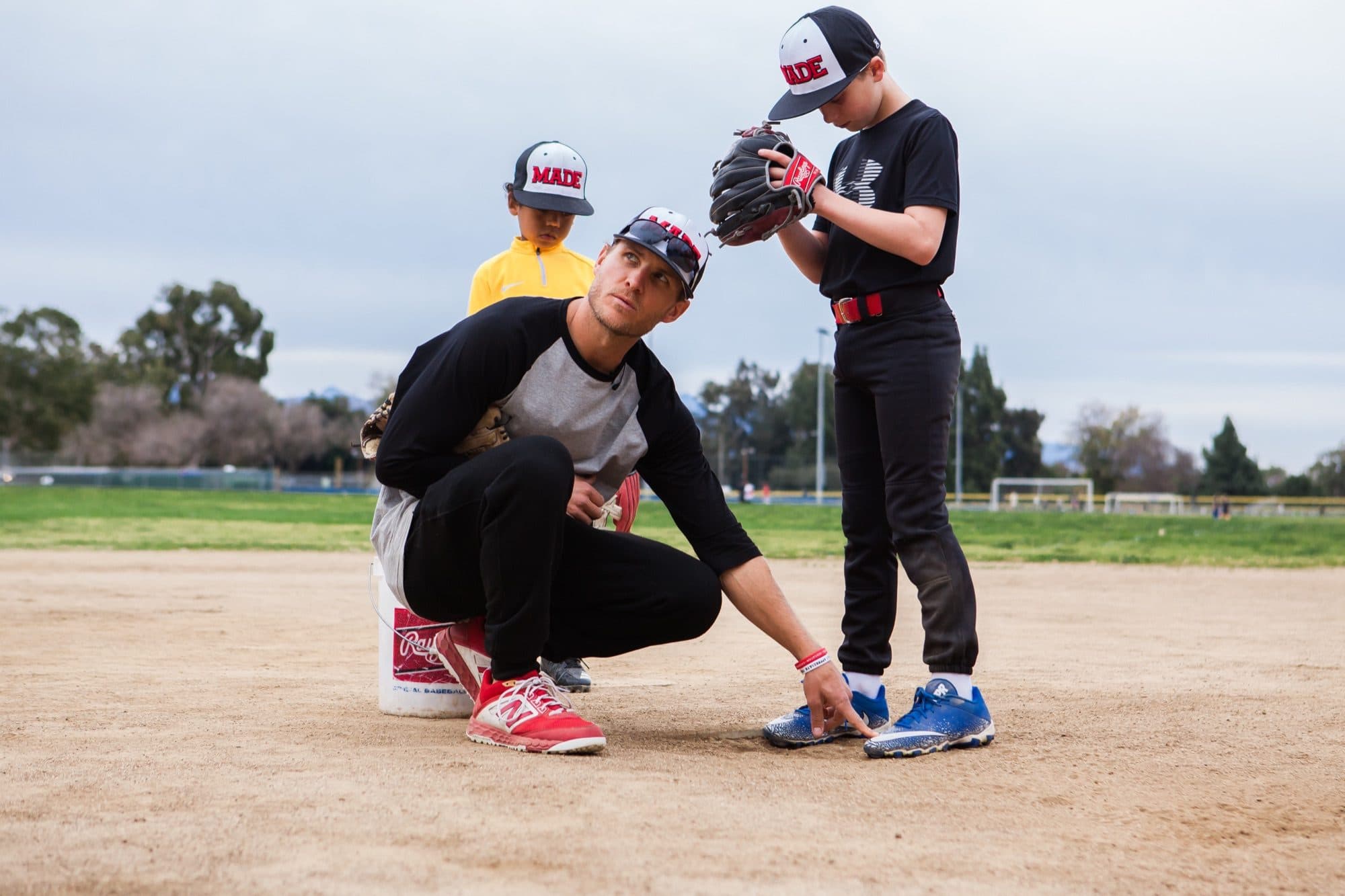
Structuring Lessons by Player Level
One size does not fit all in baseball. Here's how the curriculum actually shifts from a complete beginner to a serious travel player.
The MADE mission is to make a positive impact through the game of baseball by providing meaningful mentorship and coaching to players of all ages and skill levels, and helping them cultivate their love for the game by developing both the mental and physical skills to be the best they can be, on and off the field.
While the underlying mission stays the same at the core, the approach shifts to suit each player's age, skill level, passion, and goals. Some players move fast, others take more time, and that's fine. The job is to keep challenging a player to work hard and improve, while keeping the lesson fun and motivating.
Complete Beginner
Totally new to baseball, has never played a season on a team, and doesn't yet know the rules. Generally age 8 and under, though some players don't start until as late as 12 or even as an adult — any age above 4 is a fine place to start.
- Rules — starting with “always try your best,” and responding to a coach with “yes, coach” or “no, coach.”
- Proper gear and uniform awareness — wearing a hat, tucking in the shirt, wearing a belt, tying shoes.
- Learning the numbers — count (balls and strikes), outs, innings, bases, runs, hits.
- Learning the positions — name of each position and where it plays.
- Basic calisthenics, motor skills, and footwork — agility ladder drills, high knees, butt kickers, shuffles, carioca.
- Basic catching and throwing — how to catch safely, fun catching drills to practice.
- Basic hitting — the batter's box, how to hold the bat, how to swing, fun games to engage the player.
- Baserunning basics — running through the base, intro to sliding, intro to stealing, tagging up.
- Integrating the parent — teaching the parent basic drills and games to run at home, and bringing them into the lesson when the time is right.
Intermediate
At least 3–4 years of experience, generally ages 10–15 (occasionally as low as 8, depending on attitude and skill). They may or may not play club or travel ball, and may or may not have said they want to play in high school or beyond — but they have a solid grasp of the rules and some of the game's deeper strategy and positioning.
The goal shifts: less emphasis on the competitive side, more on reinforcing fundamentals and introducing more advanced concepts in a friendly but competitive environment. This is where a coach starts introducing strength and workout routines, and an introduction to baseball philosophy and reasoning — not just mechanics.
This is also where coaches help families navigate what's next: club ball recommendations, how much training should be happening, and the bigger questions that come up along the way. Most players work through this overview in their first 5–10 lessons.
Advanced
At least 5 years of experience, usually playing club or travel ball and tournaments, often with high school or beyond already in mind. The advanced curriculum builds directly on the Intermediate curriculum above — it doesn't replace it.
College / Professional & Adult
A college or professional player is already at the highest level and wants help continuing to refine their game and give themselves the best chance of climbing the ladder further. Adult lessons run on the same case-by-case basis — there isn't a separate curriculum to force onto either group; the fundamentals above still apply, just at a much higher baseline.