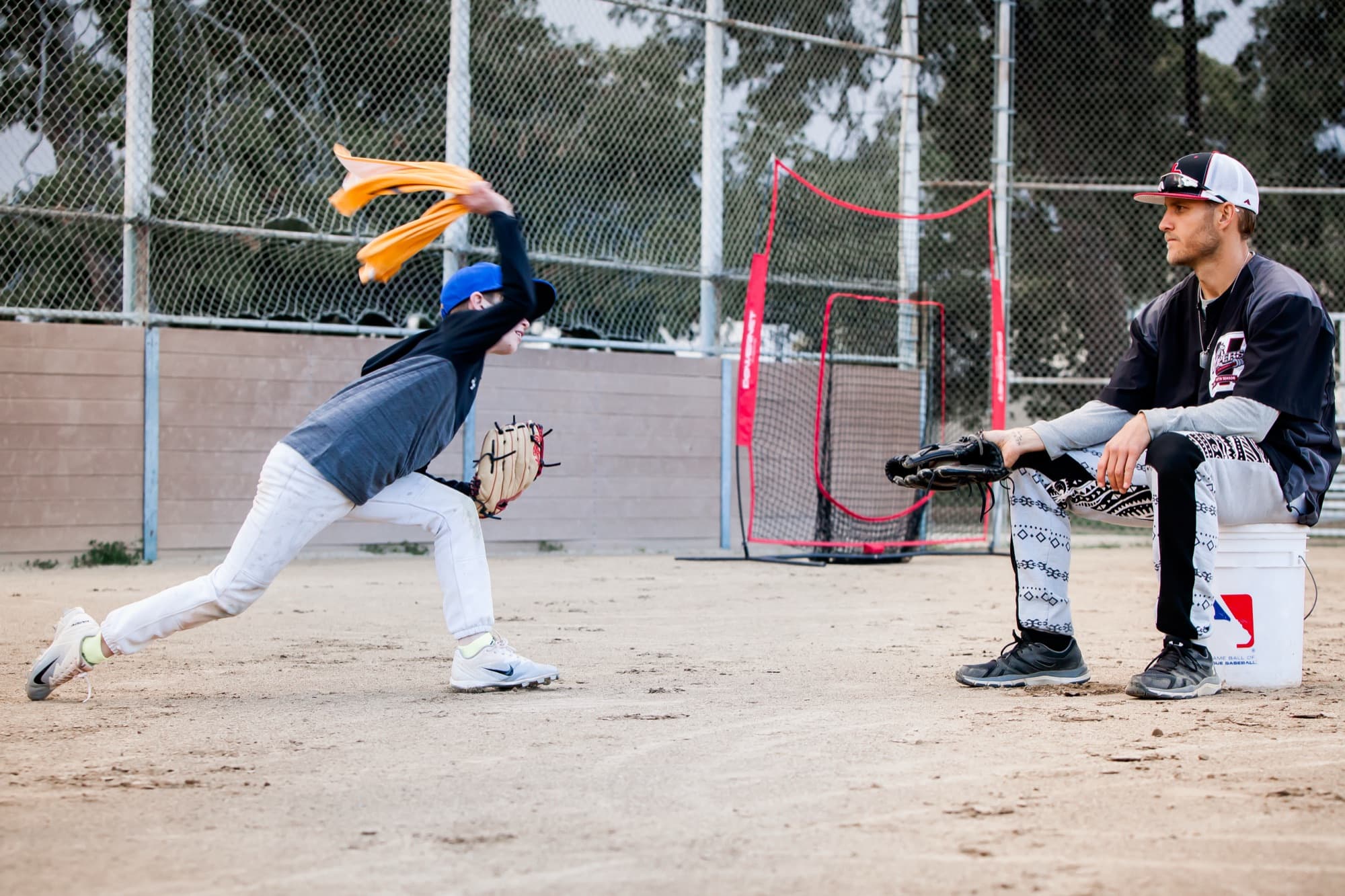
Your kid pitches on Saturday for the travel team. On Sunday the rec league coach hands him the ball too. Each coach is counting, but only inside their own game. Nobody is adding the weekend up. If you have ever wondered what the youth baseball pitch count rules are, and who is actually responsible for following them, this is the plain version.
The short answer: the limits are set by age
MLB's Pitch Smart guidelines set a daily maximum and a required rest period based on how many pitches a player threw. Here is the chart by age, as published on MLB's Pitch Smart page (checked October 2026).
- Ages 7 to 8: 50 pitches in a game at most.
- Ages 9 to 10: 75 pitches.
- Ages 11 to 12: 85 pitches.
- Ages 13 to 14: 95 pitches.
- Ages 15 to 16: 95 pitches.
- Ages 17 to 18: 105 pitches.
Rest works the same way for ages 9 to 14. A pitcher who throws 1 to 20 pitches needs no rest days. 21 to 35 pitches means one day off. 36 to 50 means two days. 51 to 65 means three days. Past 65, it is four days. For ages 15 to 16 the steps are a little higher: 30 pitches or fewer for no rest, then up to 45, 60 and 75 for one, two and three days. Ages 17 to 18 share the first three cutoffs, but three days of rest runs up to 80.
Pitch Smart also puts the job on the grown-ups. Its page says each league, travel team, showcase or tournament should set rules, and that ultimately it is the responsibility of the parent and the athlete to make sure the player follows the guidelines across a year, since kids often play in more than one league.
Little League's version
If your kid plays in a chartered Little League, the numbers come from Little League's pitch count rules. The daily limits by league age are 50 for ages 6 to 8, 75 for 9 to 10, 85 for 11 to 12, and 95 for 13 to 16. The rest chart for 14 and under mirrors the Pitch Smart steps: 20 or fewer pitches needs no rest, then 21 to 35, 36 to 50, 51 to 65 and 66 or more earn one, two, three and four days.
A few details parents miss:
- The count is based on the first pitch to each batter, and a pitcher cannot start a new batter after reaching the limit.
- No player may pitch three days in a row.
- In Minor League, Majors and Intermediate (50/70), a pitcher cannot pitch in more than one game in a day.
- A catcher who caught four or more innings in a game cannot pitch that day.
Little League's page lists its age charts for the 2026 and 2027 seasons. Your league or tournament may apply its own rules, so confirm with them before you rely on a number.
Who actually keeps the count
In Little League, each league names a scorekeeper or other official as the pitch count recorder. The recorder tells the umpire when a pitcher reaches the limit, but the same page says the manager is still responsible for taking the pitcher out even if nobody tells them. In plain words, the rule is on the coach.
That is where travel ball gets messy. Pitch Smart expects the league, team, showcase or tournament to set rules, so ask who is keeping the count in yours. Outside a chartered league, there may be no official recorder at all.
The two-team problem nobody adds up
A kid who throws well often ends up pitching for more than one team; Pitch Smart itself notes that players oftentimes play in multiple leagues. He might be on a travel roster, a rec team, a school team, and a fall team that plays a few Sundays. Each coach looks at their own scorebook and sees a healthy rested arm. Nobody sees the total.
The American Sports Medicine Institute's position statement for adolescent pitchers (page dated April 2013) says to avoid pitching on multiple teams with overlapping seasons. It also recommends no more than 100 innings in games in any calendar year, at least 4 months a year away from competitive pitching, and at least 2 to 3 months away from all overhead throwing, with 4 months preferred. Those are guidance from one research group and not a league rule, but they are the reason a Saturday and Sunday double duty deserves a conversation.
The same statement says a pitcher should not also catch for his team. Little League has a related one-day rule: four or more innings behind the plate means no pitching that day.
Warning signs to watch for
ASMI lists signs of fatigue: lower velocity, less accuracy, an upright trunk, a dropped elbow, or more time between pitches. A kid who says he is tired or looks tired should stop pitching and throwing. For elbow or shoulder pain, its advice is to stop pitching until a sports medicine physician has evaluated it. If your child has pain, talk to a doctor. This post is not medical advice.
What to ask a coach before the weekend
- Which pitch count chart do you follow, and who is keeping the count?
- Can I see the count after each game?
- If he pitched for another team this week, who adds the two together?
- Does he pitch and catch in the same game or the same day?
- What happens if the tournament does not enforce limits?
A good coach will have answers and will not be offended. If the answer is a shrug, keep your own log. Date, team, pitches, and how his arm felt the next morning. A note on your phone is enough.
Why CageList exists
This is the fragmentation problem in one example. A family's path through the game runs across leagues, teams and tournaments that do not talk to each other, and the parent is the only person who sees all of it. We built travel team pages so families can find and compare programs, and teams can list their own team and keep a page for it. We do not track pitch counts across teams today, so the log above is still your job. If you want the bigger picture of how travel ball is organized, start with our Big Travel Ball guide, the parent field guide, and our post on recovery and arm care.
Frequently asked questions
What is the pitch count limit for a 10 year old?
MLB's Pitch Smart chart lists 75 pitches as the daily maximum for ages 9 to 10, and Little League also uses 75 for league ages 9 to 10. Rest depends on the count, from no rest at 20 or fewer pitches up to four days at 66 or more.
Can a kid pitch two games in one day?
In Little League's Minor League, Majors and Intermediate (50/70) divisions, no. Junior and Senior League allow up to two games a day with conditions, and 12 year olds cannot pitch in two. Tournaments and travel organizations set their own rules, so ask.
Who is responsible if a kid pitches for two teams?
Pitch Smart says the responsibility ultimately sits with the parent and the athlete across the whole year, even though each league or team should set its own rules. Keeping your own log is the simplest fix.
How many months a year should a young pitcher rest?
The American Sports Medicine Institute's position statement recommends at least 4 months a year away from competitive pitching and at least 2 to 3 months away from overhead throwing, with 4 months preferred. Ask your child's doctor what fits your situation.
What should I do if my child has arm pain?
ASMI says to stop pitching until a sports medicine physician has evaluated elbow or shoulder pain. See a doctor rather than waiting it out.
Find a baseball league near you
Put your work into a real season: men's leagues, Little League, and travel teams, all in one guide.
Related Guides
View all articles
How to Become a Private Baseball or Softball Coach
We found no national license requirement to teach lessons for pay. Here are the credentials, background checks, insurance and taxes to look into, plus a first-month plan and how to find a place to teach.
6 min readRead
Practicing Hitting at Home Between Cage Sessions
You can not book a cage every day, but you can still get quality swings at home. Here is how to build a simple at-home hitting routine between rentals.
4 min readRead
Little League Fundraising Calendar: Fall to Opening Day
What a volunteer league should plan each season before opening day: budget, sponsor banners, concessions, donated items, state rules, tax and insurance questions.
7 min readRead
Run a travel team? Get your free page.
Baseball or softball. Claim a free directory page, post tryouts, and share cagelist.com/@yourteam with families.
Find your league
Free directories of real leagues and clubs near you. Then book a batting cage to get your reps in before opening day.
1,893 organizations
 leagues in 49 statesAdult hardball near you: MSBL, NABA and independent leagues.Browse men's leagues
 leagues in 49 statesYouth baseball and softball leagues, organized by state.Browse little leagues
 programs in 41 statesTravel and club programs in your region. Find one, or list yours free.Browse travel teams
Join the backyard batting cage community
Talk builds, gear, hosting and player development with cage owners, coaches, parents and baseball families.