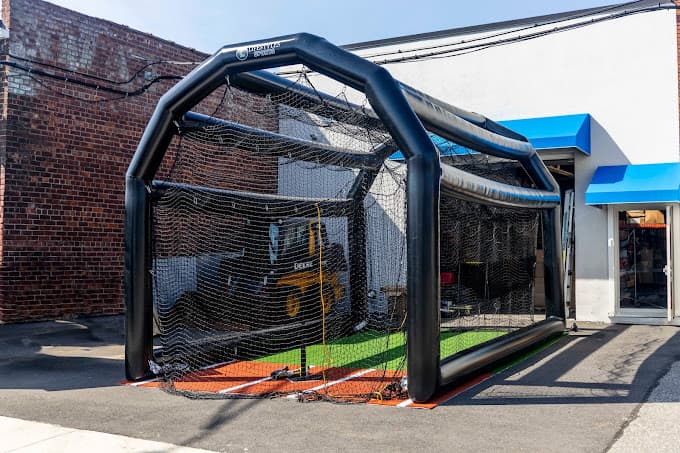
Inflatable batting cages have moved past the company-picnic novelty stage. Black arched tunnels are turning up in parking lots, on outfield grass and in a few oversized driveways, and some of them are now bookable listings rather than party rentals. If you are pricing one, the numbers are harder to pin down than the marketing suggests, because only one of the four manufacturers that matter publishes a real figure.
Here is what the tiers actually cost, the single spec that separates a serious cage from a bounce house with netting, and the arithmetic on whether renting one out pays it off.
The cage above is a real one: a heat-sealed tunnel set up in a parking lot in Wantagh, New York, and bookable by the hour on CageList.
Heat-sealed or blower-fed: the spec that decides everything
Inflatable cages split into two designs, and the split matters more than size, color or brand name.
A blower-fed cage is a bounce house with netting hung inside it. A fan runs the entire time anyone is hitting, because the structure is built to leak air. That means an extension cord out to the cage, a motor humming through every session, and a tunnel that folds in on itself the moment power drops. It is the cheap tier, and it is engineered for a four-hour birthday rental.
A heat-sealed cage is welded airtight and pumped up once, the way a paddleboard is. You inflate it, disconnect the pump, and it holds. No cord, no noise, no single point of failure halfway through a session. Every brand selling to schools and training facilities builds this way, and it is most of the reason those cages cost three to five times more.
If paying hitters are going to use it, the blower tier is out. Read the heat-sealed prices instead.
What inflatable batting cages cost in 2026
| Tier | Who builds it | Published price | What that buys |
|---|---|---|---|
| Party and rental grade | Inflatable Island, Magic Jump, Channal | Roughly $1,500 to $3,000 | Blower-fed, mostly imported, sold into the event-rental trade. One listed model sat at $1,489 on sale. |
| Entry heat-sealed | InflatableBattingCage.com (Go Smart Solutions) | "Starting under $2,000" | Six lengths from 20 to 80 feet. Per-model pricing is not published. Installment financing offered. |
| Commercial heat-sealed | Rude American | $3,999 per 20-foot section | Residential and commercial grades in four widths, 14 to 20 feet wide and 11 to 14 feet tall. Modular sections combine into 40, 60 and 80-foot runs. |
| Institutional custom | INMOTION Air | Quote only | Custom dimensions and branding. Sells to Easton, the Louisville Slugger Sports Complex and university programs. Line weights run 73 to 467 pounds. |
Rude American is the only one of the four publishing a number you can plan against, which makes it the working benchmark for the commercial tier. Use it that way, but read the unit carefully.
The sticker price is not the price
That $3,999 is per 20-foot section. Twenty feet is a hitting station. It is not a batting cage. Live BP or a pitching machine wants 40 feet at minimum, which is two sections, which is $7,998 before a single option. Then the options:
- Custom logo and color: $1,950. This is the printed branding on every photographed cage you have seen.
- Blackout upgrade: $3,450.
- Heavyweight material and netting: $999.
- Expedited production: $1,150.
- Freight: quoted per order and per location. It appears in none of the prices above, at any of these companies.
A branded 40-foot commercial cage lands near $10,000 before freight. The entry heat-sealed tier is genuinely cheaper, but with per-model pricing unpublished, treat "under $2,000" as the 20-foot starting point rather than what a 40-foot build will cost you.
Inflatable, steel frame, or permanent
| Inflatable | Steel frame kit | Permanent build | |
|---|---|---|---|
| Typical spend | $2,000 to $10,000 | Several hundred to a few thousand | Often five figures with footings |
| Setup | Minutes, by one or two people | Hours to a weekend | Contractor work and concrete |
| Moves? | Yes, deflate and store | Rarely, once tensioned | No |
| Needs anchoring | Yes, staked or ballasted | Yes | Poured footings |
| Best for | Sites you do not own, or a cage that has to be in two places | One fixed backyard | A cage that stays up for a decade |
If you are still deciding between the two conventional options, portable versus permanent walks that call in detail, and pop-up cages and nets for small spaces covers the tier below all of this.
Does it pay for itself?
Two hundred twenty-two hours is the honest payoff number for a 40-foot commercial build. At six booked hours a week, that is roughly ten months. At ten hours a week it is closer to five. The entry tier changes the shape of it completely: a $2,000 cage clears the same bar in about 56 hours, which is a single busy winter.
Run your own version of that math with the cage cost and earnings calculator before you commit to a size.
Who should buy one
- Programs that need a cage in two places. A travel org splitting one cage between fields gets something no fixed build offers.
- Renters, and anyone who cannot dig. No footings, no permit conversation, no argument with a landlord.
- Facilities with seasonal overflow. Indoor gym space in February, a parking lot in July.
- Sites with nowhere to anchor a permanent frame.
Who should buy something else
- One fixed backyard with room for a frame. A steel-frame kit with good netting costs a fraction of this and holds up outdoors for years.
- Anyone shopping on price alone. The party tier will not survive real hitting volume, and the repair conversation starts early.
- Anyone who wants the cage up permanently. These are built to be deflated and stored between uses.
Before you sign the quote
- Confirm whether the price is per section or for the finished length.
- Get freight to your ZIP code in writing.
- Confirm heat-sealed construction, not blower-fed, if hitters are paying.
- Ask for the warranty term and what a seam repair costs out of warranty.
- Ask the deflated weight and folded footprint, then find where it is going to live. Published line weights run past 400 pounds at the large end.
- Ask about the dealer program if you plan to buy more than one. Rude American runs one and does not publish its terms.
An inflatable cage is a good answer to a specific problem: you need a real hitting tunnel somewhere you cannot build one. It is an expensive answer to any other question. If you already own one and it sits idle most of the week, that is the part worth fixing next.
Shop This Guide
CageList picks that match what this article covers. No extra searching required.
Affiliate disclosure: As an Amazon Associate, CageList earns from qualifying purchases.


Get the numbers
Get your free batting cage cost estimate
Enter your email and we'll send you an itemized build breakdown: frame, netting, turf, lighting, and install, plus what a cage like yours could earn if you rent it out.
No spam, unsubscribe anytime. Prefer the interactive tool? Open the full cost calculator.
Already have a cage?
Rent it out when you're not hitting
Players, parents, and coaches near you are looking for cage time. Listing is free, you set your own price and hours, and you approve every booking.
Related Guides
View all articles
27 Types of Batting Cage: A Photo Field Guide to Every Backyard Setup in America
Barn conversions, driveway slivers, retractable tunnels, ranch cages and climate-controlled outbuildings. A photo field guide to 27 kinds of batting cage, built from 214 real bookable listings on CageList, with what each one costs and who it is for.
18 min readRead
JUGS BP1 vs BP2 vs BP3 vs mini3: Which One Fits Your Cage
JUGS BP1, BP2, BP3, and mini3, compared on the numbers that actually matter: real pitch speed range and weight, straight from JUGS's own spec pages.
4 min readReadBuying a JUGS Machine Online? Here's How to Tell a Real Dealer From a Reseller
Not every JUGS listing online is what it looks like. Here's how to tell an authorized dealer from a reseller before you spend $2,000+ on a pitching machine.
3 min readRead
Run a travel team? Get your free page.
Baseball or softball. Claim a free directory page, post tryouts, and share cagelist.com/@yourteam with families.
Find your league
Free directories of real leagues and clubs near you. Then book a batting cage to get your reps in before opening day.
1,421 organizations
 leagues in 49 statesAdult hardball near you: MSBL, NABA and independent leagues.Browse men's leagues
 leagues in 49 statesYouth baseball and softball leagues, organized by state.Browse little leagues
 programs in 41 statesTravel and club programs in your region. Find one, or list yours free.Browse travel teams
Join the backyard batting cage community
Talk builds, gear, hosting and player development with cage owners, coaches, parents and baseball families.