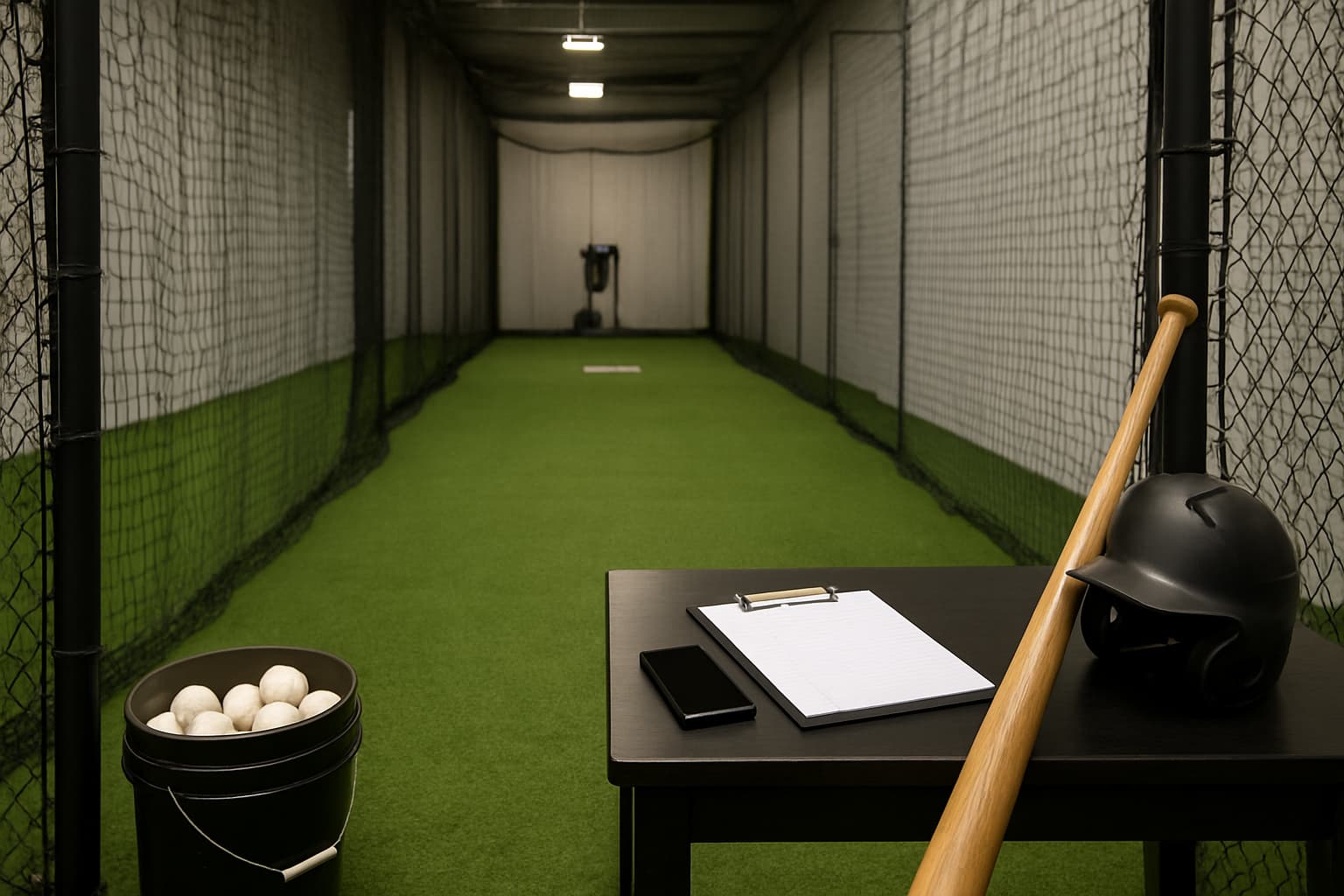
Every few weeks someone in a baseball group asks a version of the same question: I’ve got some money set aside and I’m tired of driving 40 minutes for cage time. Should I build something?
And then somebody answers “open a facility, I’d totally rent from you,” and the idea takes on a life of its own.
Here’s the part that gets skipped. These are not two sizes of the same decision. A backyard cage is an asset. An indoor facility is a job — one you paid six figures to create, that you can’t quit, and that has a five-figure quarterly bill attached whether anybody walks through the door or not.
Both can be the right call. But they’re right for completely different people, and the fastest way to lose $150,000 is to want the first one and accidentally buy the second.
Let’s put actual numbers on both.
Upfront: what you’re actually writing checks for
The backyard build
We break these down in detail in our backyard batting cage cost guide, but the short version:
| Tier | Cost | What you get |
|---|---|---|
| Budget DIY | $1,270 – $2,466 | Portable frame, economy net, no extras, you install it |
| Mid-range, rental-ready | $6,600 – $12,004 | Standalone cage, standard net, partial turf, lights, machine |
| Premium installed | $22,234 – $40,565 | Concrete footings, pro netting, full turf, enclosed, pro install |
The mid-range tier is the one that matters here, because it’s the cheapest configuration other people will actually pay to use. Lights mean evening bookings. Turf means it’s usable after rain. A machine means a kid can train alone.
Run your own numbers with the batting cage cost calculator.
The indoor facility build
Now the other side. This assumes the realistic path — leasing an existing warehouse shell, roughly 4,000 sq ft, four cage lanes, unconditioned with bay doors. Not ground-up construction, which runs $150–$250/sq ft and isn’t a serious option for a first-timer.
| Line item | Cost |
|---|---|
| Lease deposit + first/last month | $10,000 – $18,000 |
| Turf, installed (4,000 sq ft) | $10,000 – $22,000 |
| Netting, cages, suspension track, dividers | $5,000 – $16,000 |
| Pitching machines (2) | $4,000 – $16,000 |
| High-bay LED lighting | $4,000 – $12,000 |
| Warehouse fans (no A/C) | $2,000 – $6,000 |
| Restroom / ADA / front desk / minor buildout | $10,000 – $40,000 |
| Permits, change of use, certificate of occupancy | $2,000 – $10,000 |
| Training equipment (screens, tees, weights, plyo) | $5,000 – $12,000 |
| Signage | $2,000 – $6,000 |
| LLC, insurance deposits, legal, POS | $3,000 – $8,000 |
| Website, branding | $1,000 – $5,000 |
| Working capital — 6 months of fixed costs | $45,000 |
| Total | $103,000 – $216,000 |
That last line is the one that kills people. Nearly everyone budgets the turf and forgets they need to survive six months of rent while they build a customer base from zero.
The monthly nut nobody talks about
A backyard cage costs roughly $200–$600 a year to keep running. Net replacement every 5–8 years, a few balls, maybe a bulb.
A 4,000 sq ft leased facility looks like this:
| Fixed cost | Annual |
|---|---|
| Rent + NNN (4,000 sq ft, ~$12/sq ft + $4 NNN) | $62,000 – $68,000 |
| Insurance (GL, participant accident, abuse/molestation) | $3,000 – $7,000 |
| Utilities (lighting, fans, machines) | $6,000 – $10,000 |
| Software + payment processing | $8,000 – $11,000 |
| Bookkeeping, CPA, filings | $3,000 – $6,000 |
| Total fixed | $82,000 – $102,000 |
Rent is the line most sensitive to where you are. Small-bay industrial space under 50,000 sq ft carries a real premium and sits at sub-5% vacancy in most markets, so $12/sq ft base is a Midwest or inland-South number. On either coast, double it and rerun everything below.
Call it $7,500 a month before a single lesson gets taught. Every month. In July when it’s 94° in a building with no air conditioning and nobody’s booking. In December when half your families are traveling.
The backyard cage has no such clock. If you don’t rent it for two months, you’ve lost nothing but opportunity.
Capacity: why the facility ceiling is lower than it looks
Four cage lanes sounds like a lot until you map when people actually train.
Youth baseball demand lives weekdays 4–9pm and weekends. That’s it. Weekday mornings and early afternoons are school hours — dead inventory you pay rent on.
| Prime window | Lane-hours/week |
|---|---|
| Weekday prime (4 lanes × 5 hrs × 5 days) | 100 |
| Weekend (4 lanes × 9 hrs × 2 days) | 72 |
| Total sellable prime inventory | 172 |
At $55/hour, 172 lane-hours is $9,460 a week — $491,920 a year if you sold every prime hour, every week. Nobody does. Two things eat it.
First, seasonality:
| Period | Demand |
|---|---|
| January – May | Peak, 100% |
| June – August | 50–65% (field season is busy; the building is brutal) |
| September – October | 80–90% |
| November – December | 60–70% |
Weight those out and you get roughly 42 effective weeks of demand, not 52 — call it $400,000 of prime inventory that anyone actually wants to buy.
Second, sell-through. A facility that quotes rentals by hand off a PDF rate sheet realistically sells 25–40% of the hours it could. That puts the honest revenue ceiling on rentals alone somewhere around $100,000–$160,000, against $82,000–$102,000 of fixed cost.
Read that again. At the good end you clear about $58,000 before you pay yourself, staff anyone, or replace a machine. At the bad end you lose money. Rentals alone do not make a facility work. The math only closes when you stack lessons, camps, memberships, and a travel program on top — which is to say, when you build a business, not a building.
The part that isn’t on any spreadsheet: your hours
| Backyard cage | Indoor facility | |
|---|---|---|
| Setup time | A weekend, or one install day | 3–6 months |
| Weekly time commitment | 1–2 hours | 50–70 hours |
| Can you keep your day job? | Yes | No |
| If you take two weeks off | Nothing happens | Revenue stops, bills don’t |
| Staff to manage | None | Coaches, camp staff, front desk |
| Personal financial liability | Cost of the cage | Personal guarantee on a 3–5 year lease |
| Exit if you hate it | Sell the net and frame | You still owe the lease |
That 50–70 hours isn’t an exaggeration. A solo facility owner is quoting every rental by hand, scheduling four lanes against lessons and camps and team practices, running registration, chasing unpaid dues, managing coaches, posting to Instagram, and — if they’re lucky — actually coaching.
Year three is the fork. By then the thing either stabilizes into a real business with staff, or it plateaus and you realize you bought yourself a job that pays less than the one you left. Most first-time facility owners hit that wall around month 30 and have never once modeled it in advance.
“We’d be using it anyway” — the most common reason people build, and where it breaks
Let’s name the person who actually reads this article, because it usually isn’t an investor running a spreadsheet.
It’s someone who loves baseball, has a kid in it, and has some land. The reasoning goes: my kid is going to be hitting for the next eight years either way. I’m already paying for cage time. I’ve got the space. If I build it, at least the money stays with us — and if other people want to use it, even better.
That’s a genuinely good instinct. It’s also the single most reliable way people talk themselves into the wrong one of these two builds — because the logic is strong for a backyard cage and it inverts completely for a facility.
Why it holds up in the backyard
Your real break-even isn’t the build cost. It’s the build cost minus what you were going to spend on cage time anyway.
A family renting two hours a week for 40 weeks at $40/hour spends $3,200 a year. Nothing about that money comes back. Put the same spend against a $9,000 rental-ready build and you’ve paid for the cage in under three years with zero renters. Every hour anybody else books is upside on a purchase you’d have defended to your spouse regardless.
That’s a real asset argument, and it’s why so many of the best cages on CageList belong to families who never set out to be in the rental business.
Why it collapses at the facility
Run the identical sentence against four lanes and a lease and it falls apart three ways.
The offset is a rounding error. Your kid uses maybe four of 172 prime lane-hours a week. You are not meaningfully offsetting an $82,000–$102,000 fixed cost with your own family’s use — you are buying $3,200 of personal cage time for $90,000 a year.
Your family competes with your customers. The hours your kid needs are 4–9pm on weekdays and weekend mornings — the exact hours you have to sell to survive. In a backyard, personal use fills dead time. In a facility, every hour your own team takes is an hour of prime inventory you didn’t sell. The use case that justified the build actively cannibalizes the thing paying for it.
Your reason has an expiration date and the lease doesn’t. A 10U is eight years from his last high school at-bat. A commercial lease is three to five years with a personal guarantee on it, and you will very likely sign a second one. There is a real chance you are still running this business, still on the hook, after the kid it was built for has stopped playing. Ask anyone who owns one — that conversation happens more than you’d think.
What a backyard cage actually earns
Here’s where people get oversold, so let’s be careful. A backyard cage is not a business. It’s an asset with a payback period, and the payback depends entirely on how many people live near you.
Assume a $9,000 mid-range rental-ready build at $40/hour, hosts keeping 90%, across 40 bookable weeks a year:
| Demand level | Hours/week | Annual net | Payback |
|---|---|---|---|
| Slow market | 2 | $2,880 | ~3 years |
| Typical suburb | 5 | $7,200 | ~15 months |
| Dense youth-baseball area | 8 | $11,520 | ~9 months |
That $40/hour isn’t a guess. Across the 218 backyard cages currently listed on CageList, the median rate is exactly $40 an hour — and the middle of the range is where almost all of the booking volume lives.
Your time cost across all three rows: an hour or two a week. Messages, gate access, occasional cleanup.
The honest caveat: the slow-market row is real. If you’re 30 minutes from the nearest travel program, treat the rental income as a bonus that offsets a cage you wanted anyway — not as an investment thesis.
Model your own market with the cost and ROI calculator.
The thing most people get backwards
A backyard cage doesn’t compete with an indoor facility for team practice. A full team needs 4+ lane-hours per session and a coach’s eye on multiple stations at once. One backyard cage can’t do that, and pretending otherwise makes you look like you’ve never run a practice.
What a backyard cage competes for is the other 80% of cage demand — the demand no facility is set up to serve well:
- A kid who needs 45 minutes of reps on a Tuesday, not a scheduled hour-long block
- Pre-game swings the morning of a tournament
- Off-day work in the two weeks between seasons
- Two or three teammates splitting a session
- The rain plan — and in Florida, from June through September, this one is enormous
That last one is underrated. Afternoon storms wipe out outdoor practice constantly, and a team organizer’s entire week can evaporate. Being able to book an available cage the same afternoon, without a facility contract, is the cheapest insurance in youth baseball.
Running a travel team: what the demand side actually needs
If you’re building a cage to rent, it helps to understand your customer. Here’s what one 12U travel team costs to operate for a year, assuming two practices a week.
| Requirement | Detail | Annual cost |
|---|---|---|
| Sanctioning / roster registration | USSSA, Perfect Game, Triple Crown | $200 – $500 |
| Team insurance | GL + accident, often via the sanctioning body | $200 – $800 |
| Tournament entries | 8–14 events at $500–$1,500 | $5,000 – $14,000 |
| Uniforms | 12 players × $150–$300 | $1,800 – $3,600 |
| Equipment | Balls, screens, tees, catcher’s gear, helmets | $1,500 – $3,000 first year |
| Background checks / SafeSport | Per coach | $25 – $50 each |
| Practice space | 8 lane-hours/week × 40 weeks | $0 – $9,600 |
| Coaching | Volunteer parents, or paid | $0 – $6,000 |
| Communication tools | Team app, group messaging | $0 – $300 |
| Team operating total | $24,500 – $28,500 | |
| Per player (12-man roster) | $2,040 – $2,375 |
Now look at the practice-space line. It’s the only cost on that list with a $0 option, and it’s the second-largest number when it isn’t zero. That’s the whole opportunity.
A realistic two-practice week
| Day | Block | What happens | Cage need |
|---|---|---|---|
| Monday | — | Recovery / off | — |
| Tuesday | 6:00–8:00pm | Team practice: defense rotations + hitting stations | 2 lanes × 2 hrs |
| Wednesday | Open | Individual reps, optional | 1 lane × 1 hr |
| Thursday | 6:00–8:00pm | Team practice: situational + live BP | 2 lanes × 2 hrs |
| Friday | Evening | Pre-tournament tune-up swings | 1 lane × 1 hr |
| Saturday | All day | Tournament | — |
| Sunday | All day | Tournament, or make-up practice if rained out | Variable |
Team total: ~8 dedicated lane-hours per week, plus 2–4 individual hours that families arrange themselves.
Those individual hours are the ones that go looking for a backyard cage. A team organizer books the facility for Tuesday and Thursday. The parents book whatever’s nearby for everything else.
The test: which one are you?
Ask yourself one question, and answer it honestly.
If the honest answer is I just want my kid and a few others to be able to hit whenever — build the backyard cage. Spend $7,000–$12,000, list it, let it pay for itself over a year or two, and keep your evenings.
If the honest answer is I want to build a program, coach full-time, employ people, and this is my next career — then the facility might be right. But go in knowing you’re signing a personal guarantee, working 60-hour weeks, and clearing a $7,500 nut every month before you earn a dollar. Have the six months of working capital. Model year three before you sign year one.
What you should not do is buy the facility because you wanted the cage. That mistake is common, expensive, and takes three years to become obvious.
Start with the smaller decision
The backyard route has a property the facility route doesn’t: you can find out if you’re wrong for $9,000 instead of $150,000.
Build the cage. List it. See what your market actually does with it over six months. If you’re turning away bookings every week, you’ve just validated demand with real money — and that’s a far better basis for a lease conversation than a hunch and a spreadsheet.
If you’re not, you still have a cage in your backyard and your savings.
- Price your build and estimate rental income
- Read the full backyard cost breakdown
- List your cage on CageList
Already run a facility? Claim your page and get in front of the players searching your market: list a facility on CageList.
Put your cages in front of more local hitters
CageList is built to help cage owners reach players, parents, coaches, and teams looking for time.
Related Guides
View all articles
Facility Owners
How Batting Cage Facilities Fill Their Empty Weekday Hours
Most batting cage facilities sit half-empty on weekday mornings. Here is how to turn that idle daytime into steady, low-effort recurring revenue.
List Your Cage
Can Your Little League Rent Out Its Batting Cage?
Most leagues own a cage that sits idle most of the year. Opening it up is usually allowed — it depends on who owns the ground, what your use agreement says, and what your liability policy covers. Here is how to check all three.
Find & Rent Batting Cages
What You Actually Get at a HitTrax Cage in Dick's Sporting Goods
Dick's runs two different services in the same HitTrax cage, and they cost very different amounts. Here is what you get, what it costs, and when a real cage is the better call.
Run a travel team? Get your free page.
Baseball or softball. Claim a free directory page, post tryouts, and share cagelist.com/@yourteam with families.
Find your league
Free directories of real leagues and clubs near you — then book a batting cage to get your reps in before opening day.
1,000 organizations

Join the backyard batting cage community
Talk builds, gear, hosting and player development with cage owners, coaches, parents and baseball families.